I have often wondered where art truly lives. As the curator of The Evelyn Glennie Collection, I reflect on whether art lives in quiet, dust-lit rooms where the past breathes through scores, paint, and other artefacts, or is it somewhere ahead of us, waiting in the imagination of a child who has not yet created their first work?
The more I think about it, the more I realize that art lives in the space between memory and the future.
Memory is where everything begins. Every artistic gesture, brushstroke, note, word, or movement carries traces of those who came before us. When we encounter art from the past, we are not just observing objects or performances; we are encountering the voices of people who once tried, as we do now, to understand their world.
Perhaps this is why listening has always felt so central to me — not just hearing, but truly listening to the stories carried within art, to the silences between notes, to the emotions hidden within an image or a line of text. Listening, to me, is one of the most powerful ways we connect with memory.
I have often wondered where art truly lives.
The more I think about it, the more I realize that art lives in the space between memory and the future.
Memory is where everything begins.
When we encounter art from the past, we are not just observing objects or performances; we are encountering the voices of people who once tried, as we do now, to understand their world.”
Through listening, the arts become a living archive of humanity. They hold our contradictions, our struggles, and our celebrations. They remind us that creativity has always been one of the ways we survive history by transforming experience into meaning.
However, I don’t believe memory alone is enough.
If art were only preservation, it would become a museum of echoes.
Artists are, in many ways, professional explorers. They move into territories that have no maps yet, they experiment with new technologies, new narratives and new ways of experiencing.
The future, therefore, is not a distant destination. It is something that is constantly being imagined into existence through artistic practice.
To imagine the future, we must first learn how to listen to the past, to each other, and to emerging voices that have not always been heard. ”
If art were only preservation, it would become a museum of echoes. The true vitality of the arts lies in their restless movement toward the future. Artists are, in many ways, professional explorers. They move into territories that have no maps yet, they experiment with new technologies, new narratives and new ways of experiencing.
The future, therefore, is not a distant destination. It is something that is constantly being imagined into existence through artistic practice.
What fascinates me most is that memory and future are not opposites. They are collaborators.
This is where listening becomes essential. To imagine the future, we must first learn how to listen to the past, to each other, and to emerging voices that have not always been heard. This has become a personal mission of mine and that of The Evelyn Glennie Foundation: to remind people that listening is not passive. It is an act of attention, humility, and imagination. It is how we truly encounter creativity.
Supporting the arts is not simply an act of generosity — it is an act of stewardship and imagination at once.
To support memory is to protect cultural ecosystems…
To support the future means investing in the unknown…
Philanthropy, at its best, becomes a bridge between these two responsibilities.”
This delicate balance becomes especially visible when we consider the role of philanthropy in the arts. Supporting the arts is not simply an act of generosity — it is an act of stewardship and imagination at once.
To support memory is to protect cultural ecosystems: museums that safeguard our collective heritage, theatres that revive great works, archives that preserve fragile histories. These institutions allow us to remain connected to the stories that formed us.
To support the future means investing in the unknown, in experimental artists, emerging voices, untested ideas. It means accepting that the most transformative works are often those that initially feel uncertain or disruptive.
Philanthropy, at its best, becomes a bridge between these two responsibilities.
Another dimension of this bridge is the intergenerational exchange that sustains artistic communities. Tradition does not survive simply by being preserved; it survives by being reinterpreted. Each generation receives a cultural inheritance but also reshapes it through its own experiences and questions.
If we listen carefully, we realize that the arts are a continuous dialogue across time.
Supporting artists cannot be limited to occasional funding or recognition.
Artists need spaces where experimentation is possible without fear, where failure is not a catastrophe but part of the creative process.
In other words, caring for the future of the arts means caring for the people who imagine it.
When we listen, the arts reveal something extraordinary: they allow us to look backward without becoming trapped in nostalgia, and to look forward without losing our sense of identity. ”
In this sense, the relationship between generations is not hierarchical but conversational. Wisdom flows from past to future, while new perspectives travel in the opposite direction, challenging assumptions and expanding possibilities.
If we listen carefully, we realize that the arts are a continuous dialogue across time.
Artists themselves often live in fragile conditions. The world celebrates creativity, but the people who dedicate their lives to it frequently face instability and invisibility. If we want the arts to thrive between memory and the future, we must also rethink how we care for those who create them.
Supporting artists cannot be limited to occasional funding or recognition. It must involve building ecosystems of wellbeing, and structures that value emotional, social, and economic sustainability. Artists need spaces where experimentation is possible without fear, where failure is not a catastrophe but part of the creative process.
In other words, caring for the future of the arts means caring for the people who imagine it.
And perhaps it also means teaching the world to listen more deeply — listening to artists, listening to communities, and listening to the subtle signals of change.
When we listen, the arts reveal something extraordinary: they allow us to look backward without becoming trapped in nostalgia, and to look forward without losing our sense of identity. They are both mirror and window. A mirror, because through them we recognize who we have been — our histories, our cultures, our collective memory. A window, because they open our view toward possibilities that we have not yet imagined.
Those of us who care about the arts, whether as artists, supporters, thinkers, or philanthropists, participate in a quiet but powerful act: we help carry human creativity across time.
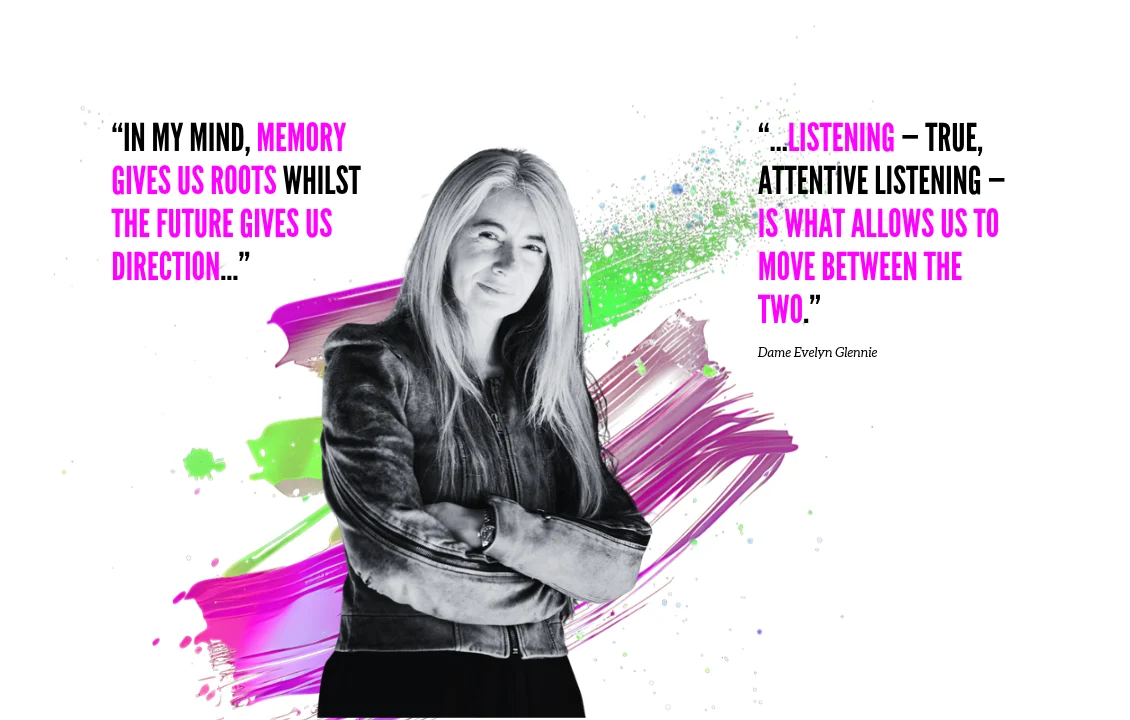
In my mind, memory gives us roots whilst the future gives us direction. Listening — true, attentive listening — is what allows us to move between the two.”
Standing between these two perspectives is both a responsibility and a privilege. Those of us who care about the arts, whether as artists, supporters, thinkers, or philanthropists, participate in a quiet but powerful act: we help carry human creativity across time.
In my mind, memory gives us roots whilst the future gives us direction. Listening — true, attentive listening — is what allows us to move between the two.
Evelyn
Originally written as a submission for inclusion in Arts Philanthropy, a brochure produced for Strategic Philanthropy for the Arts – Between Memory and Future: Arts as a Mirror the the Past and Window on the Future Forum, in which Evelyn participated, held in Lugano, Switzerland on 23rd October 2026.