Originally published as a pdf in April 2019, this post last reviewed June 2026
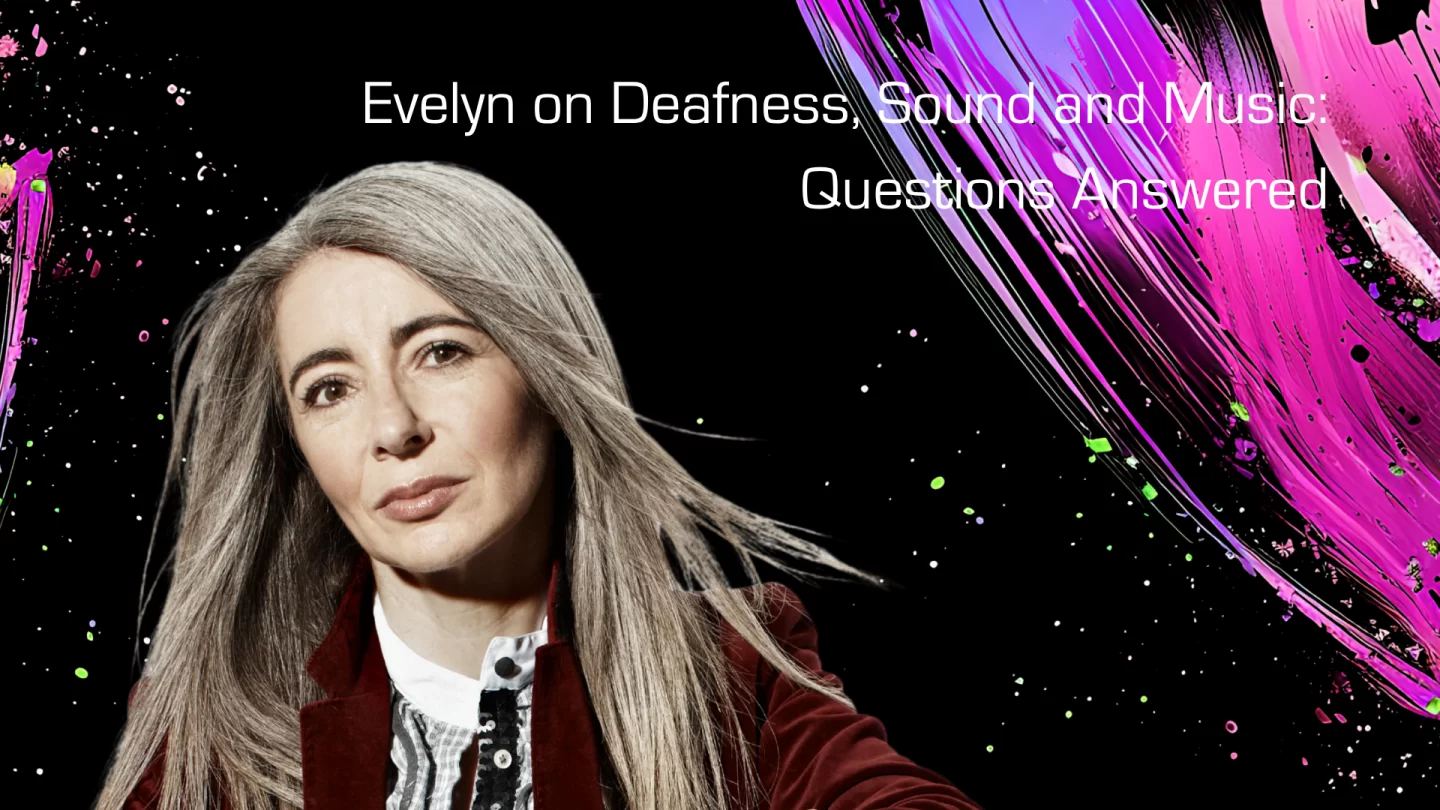
This article aims to answer the most frequently asked questions relating to Evelyn, her deafness, how she experiences sound and how she ‘hears’ music.
These answers may be of particular interest to children following the Beehive NCERT* Textbook in English for Class IX (Class 9), who are studying “Chapter 2: The Sound of Music Part 1 – Evelyn Glennie Listens to Sound without Hearing it”, written by Deborah Cowley.
We cannot get confused between hearing and listening – hearing is a medical condition which can be measured whereas listening is an act of choice which goes beyond hearing a sound. Anyone can engage in the act of listening should they make that choice.”

When did you start going deaf?
I started going deaf from the age of 8 due to nerve deterioration. I began to complain about my ears being sore when I was riding on my bike in strong winds. I went to the doctor and was given some ear drops to help. However, it gradually grew to the point where I avoided going outside to avoid the wind.
At the age of 11 my hearing became so poor that I needed to be fitted with hearing aids immediately. I was told that I would have to attend the Aberdeen School of Deaf in Scotland. I refused to go there as I wanted to remain at a mainstream school.
Do you wear hearing aids?
From the age of 11 and during my school days I wore hearing aids and a phonic ear in the classrooms. However, I discovered that by turning up the volume on the hearing aids, sound often became more confusing and less clear. At first, I thought the only way to hear better was for everything to be louder, but that was not the case at all. When sound increased in volume, it actually became distorted and confusing. Everything was much more painful and more difficult to decipher, and my balance was affected. I learnt that by taking off my hearing aids, I heard less through the ears but much more through my body. My body acted like a resonating chamber.
How can you be a musician if you are deaf?
It is worth pointing out that I am not totally deaf, I am profoundly deaf. Profound deafness covers a wide range of symptoms, although it is commonly taken to mean that the quality of the sound heard is not sufficient to be able to understand the spoken word from sound alone. With no other sound interfering, I can usually hear someone speaking although I cannot understand them without the additional input of lip-reading.
Deafness is poorly understood in general. For instance, there is a common misconception that deaf people live in a world of silence. To understand the nature of deafness, first one has to understand the nature of hearing. Deafness does not mean that you can’t hear, only that there is something wrong with the ears. Even someone who is totally deaf can still hear/feel sounds. Read my Hearing Essay if you wish to explore this question further.
Without hearing, how are you able to perform so well?
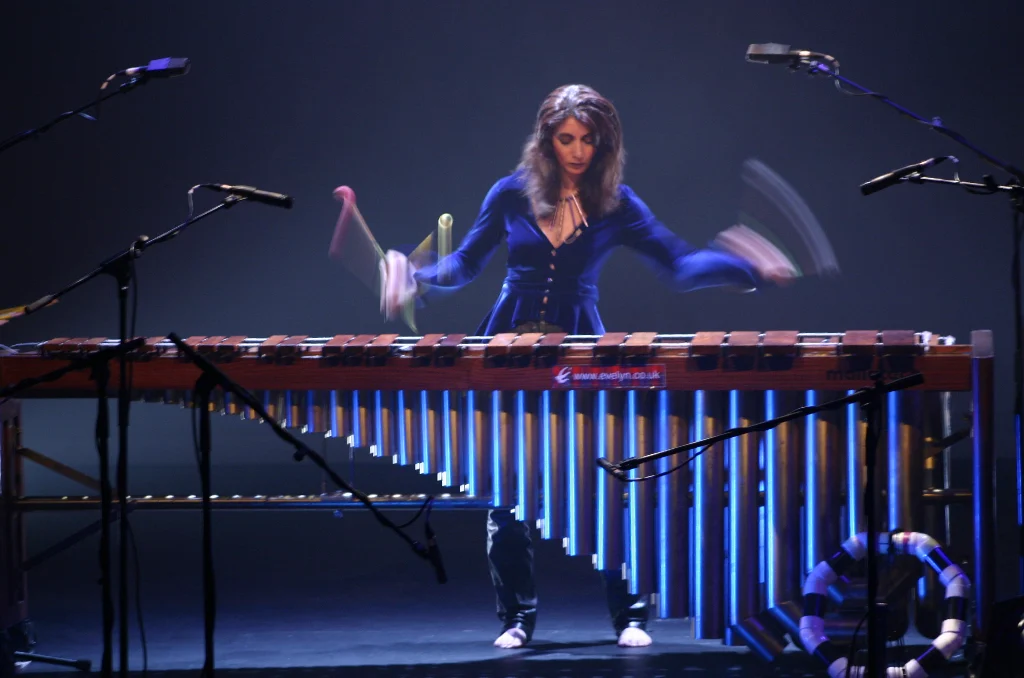
I often perform barefoot. This allows me to feel the vibrations through my feet. In fact my whole body is like a huge ear in that I can use it to register rhythms, textures, dynamics and so on. Pitches can be registered by physically feeling them if they are played in isolation.
How do you know what music sounds like?
I know how music sounds by what I feel and see. I can sense musical sound throughout my whole body. I can identify different pitches in isolation according to which part of my body feels the vibrations and for how long.
My Percussion teacher at school, Mr Forbes, taught me how to develop my senses. He used to tell me to put my hands on the wall of the music room and he would play two notes on two timpani and ask me, ‘Which is the higher note?’ I’d tell him which I thought it was, and he’d ask me, ‘How do you know?’ I would tell him I could feel it perhaps in the upper part of my hand, whilst I felt the lower note all the way down to my wrist. Or we would discuss what was happening in my feet and legs as I played the drums. Similarly, I always knew when a door banged or the phone rang.
My ability to sense sound developed as I became more and more dependent upon it. Eventually I managed to distinguish the rough pitch of notes by associating where on my body I felt the sound and with the sense of perfect pitch I had before losing my hearing. The low sounds I feel mainly in my legs and feet and high sounds might be particular areas on my face, neck and chest.
Can anyone listen like this?
It is possible to develop this way of listening over time. If you put your hands on both sides of a piece of paper or hold a balloon when a radio or TV is on or when someone is speaking, singing or playing music, you can feel the vibrations coming through the paper or balloon. Many people have experienced the vibrations that pour through the lower limbs of the strong bass and drum beats of a ‘high-powered’ discos or pop concerts.
How do the vibrations feel as you pick up sound? Is it something you can explain?
One cannot explain the feelings easily as it depends where you stand/sit in relation to the instrument, which instrument is played and its frequencies, the acoustics of the room, the quality of the instruments, the dynamics used, what one is wearing and so on. There are too many variables to describe the actual feeling. Please read my Hearing Essay which may assist you with more information.
What does it feel like when you are teaching someone to feel music? Can you sense the same vibrations they are experiencing?
It feels very rewarding to open the door to someone and have them realize that they can experience sound through their body rather than only through the ears. I cannot say whether we each feel exactly the same vibrations/sensations but at least the mechanism we use is similar.
Do you hear sounds exactly as your friends do? It’s important to know that there would always be a difference in what is felt as a participator of creating sound to that of the passive listener. Even someone sitting in the front row would experience different physical sensations to someone sitting in the 3rd row or in the balcony and so on.
What kind of emotions or feeling do you get when you play different instruments?
I play so many instruments within the percussion family that it is impossible to describe every single feeling. Low sounds from instruments such as timpani and bass drums are felt mainly in the lower part of my body whereas high sounds from glockenspiels, triangles, cymbals are felt in the upper part such as the neck, cheekbones or scalp. Instruments such as Tam Tams can be felt all over the body.
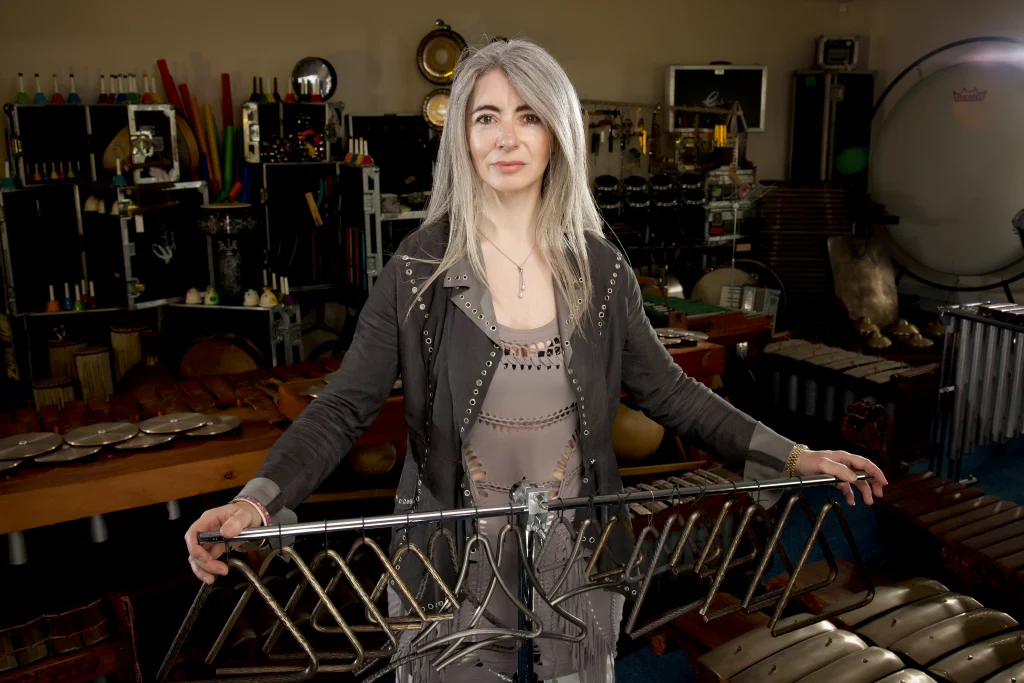
Please bear in mind that these feelings happen when one participates in the actual playing of these instruments. One may have a different sensation by being a passive listener.
How does your hearing-impairment affect the way that you speak/vocalise with others?
I use my voice. Because I was born hearing I understand about accents, inflection, dynamics, placement of sound, acoustic awareness, formation of words, structure of sentences and so on. If I haven’t heard or used a word for a long time, I forget how to say it and therefore it’s more challenging to say the word.
Being a musician gives me so much information as regards to sounds around me which is the same for when I’m in conversation with people. Visual awareness is crucial in how I listen.
How would you describe the way that you hear music? And with this in mind, how did you come to learn this alternative way?
I hear music through my body, as we all do unless there is paralysis. Vibrations are fed throughout my body which I then make sense of in relation to how I perform. I listen (feel) the beginning, middle and end of sounds rather than only the initial impact.
My percussion teacher at school asked me to take off my hearing aids so that less sound could be heard through my ears but more through my body. Overload can happen when too much sound comes through the ears but more sound can be tolerated and made sense of when fed throughout the body.
How did you get into music? And at any point did you feel you would give up this passion due to the difficulty of not hearing?
I started piano from the age of 8 which was through Scottish traditional music at home and school. I started percussion from the age of 12 after seeing the school orchestra 8 play during one assembly for all new pupils. I never had the feeling of giving up because my teacher was completely dedicated to my situation and I too was dedicated and worked hard.
There was nothing I could do about my deafness as that is a physical condition but I could steer people’s attention to the need of creating repertoire to sustain a solo career not only for myself but for generations to come.”
When playing percussion instruments you feel vibrations in a particular way. Is this similar to a pianist?
I play piano and percussion. All instruments are different and therefore the feeling from each varies considerably. There are no ‘particular ways’ in feeling vibration as it depends on too many variables such as what you’re wearing, quality of instruments, type of instruments, standing, sitting, type of stage, materials of the room such as wood, curtains, brick etc. Vibration is a moving, fluid entity – never static so there is not a set way to digest sound as vibration. It is unique to each person.
Do you think you’d have had the same career as a musician if you’d not lost your hearing?
I cannot really answer this because I simply don’t know. I do know that I have acquired a sense of curiosity towards digesting sound using the body. I create sound how I understand it and then let it go. I don’t try to replicate what I have done before because the physical feel is different each time. The body has to feel a sound as though it’s the first time it has been experienced. That’s why I’m not bound by systems or methods of playing. This has all aided me in exploring things in ways that are pertinent to my situation.
Basically, I have to listen to myself before listening to others which in turn helps me to at least try to listen to others better. I cannot listen to others if I can’t listen to myself first. We cannot get confused between hearing and listening – hearing is a medical condition which can be measured whereas listening is an act of choice which goes beyond hearing a sound. Anyone can engage in the act of listening should they make that choice.
Did hearing loss give you an added impetus and determination to be a musician? Might you have ended up with a “proper” job if things had been different?
I’m a fairly determined person, so at the age of 15 once the decision had been made to try music as a profession, that was that!
My determination was to carve a career as a solo percussionist on a full-time basis which had not existed before. That was actually my main challenge. The media focused on my deafness whilst the concert promoters focused on putting on percussion recitals and concertos often for the first time. In a way it was the creation of the solo career that made me determined and focused. There was nothing I could do about my deafness as that is a physical condition but I could steer people’s attention to the need of creating repertoire to sustain a solo career not only for myself but for generations to come.
When playing in a group, how heavily do you rely on the written score to play along with other musicians – and are you aware if someone else makes a mistake?
If the performance is totally improvised, it is important for me to see the musician(s) otherwise I cannot rely on the sound alone. That’s the case with playing notated music too whether with my pianist in a recital or playing a concerto with an orchestra. In the latter case, I nearly always try to position my instruments to a 90% angle to the audience so that the majority of the orchestral players can see me and I can see the majority of them. The conductor has to be as close to the edge of the stage as possible so that we can see each other.
I learn the music from the full score so that I know what the other musicians are doing. As regards to others making a ‘boo boo’, I sometimes pick this up especially if I know the piece inside out and if the mistake has come from the brass, winds or percussion. I get the impact of their sound much better than strings. Also their sustain is more direct than strings which gives me more time to digest the sound. I usually place my mallet percussion (marimba, vibraphone and so on) on the cello side so as not to cancel the register of the violins, and it gives me better contact to separate the brass/wind sound from the type of sounds the mallet percussion produces. The drums are placed on the violin side in order to allow the strings to be more on top of the beat and for me to separate the drums from the brass a little more.
How do you manage to improvise along with other musicians – and how do you cope with duets? For example in the piece Extra Sensory Perception with Trio HLK you play a duet with some fairly quiet piano.
With ESP I’m relying on the click throughout. I obviously have an understanding of the structure and mood of the piece which allows musicality to come through. However, I need to develop improvising more with melody.
Pitch is the hardest thing to digest because I get the impact of the sound (not if too soft) but I miss the actual pitch itself, so to interact or follow chordal progressions with others can be a real challenge. Improvising soundscapes, moods, rhythms are much easier because I’m less reliant on actual melodies or complex harmonic structures and often I’m playing non-pitched percussion.
As long as I can see the musicians when playing free improvisation then I’m usually fine. With some collaborations I am initially reliant on the written score and over time I have felt more confident to understand the often complex harmonic progressions let alone rhythmic complexities in order to open the door a little wider in my playing. Feeling more comfortable is also down to having played with different musicians and knowing them socially and professionally.
A collaboration takes time, and getting to know people away from the concert platform really helps to understand their approach to performances or why things are performed in such a way and so on. Getting to know musicians away from the platform has been as important as what happens on stage.
When you’re learning a piece, how do you know you’ve got it “right”? Especially on the Marimba – do you know you’re hitting the right combination by sight or is your body perception good enough to know if the correct combination of notes are being hit?
It’s by sight. I’m often playing on many different models of instruments whereby the height, width of bars, spacing between bars etc. varies. I have to rely on sight. I’m often playing too quickly or too many notes whereby the body is constantly moving that I cannot personally determine which pitches are being played.
If I play timpani in isolation (with no other instruments) I can more often than not determine the actual pitches because the sound is isolated, timpani resonates much more than a marimba, I’m physically closer to each drum, I’m moving less, the sound reaches a greater part of the body and the sound is generally louder than a marimba.
How do you approach writing pieces in collaboration with an ensemble?
I like to work closely with the musicians I’m working with so that they become part of the writing/creative process. I like for them to contribute and stretch the boundaries of my ideas and vice versa. This is very much what happened when I co-wrote the score for Troilus and Cressida for the Royal Shakespeare Company in 2018. All of the musicians brought their own musical voices to the score which often meant notating things became a tad challenging!
I create sound how I understand it and then let it go.”
For more information on this topic, please also read Evelyn’s Hearing Essay, originally published in 2015, here, and watch ‘Feeling Sound with Evelyn Glennie‘ available through Evelyn’s YouTube channel and embedded below:

* NCERT = National Council of Educational Research and Training, New Delhi, India